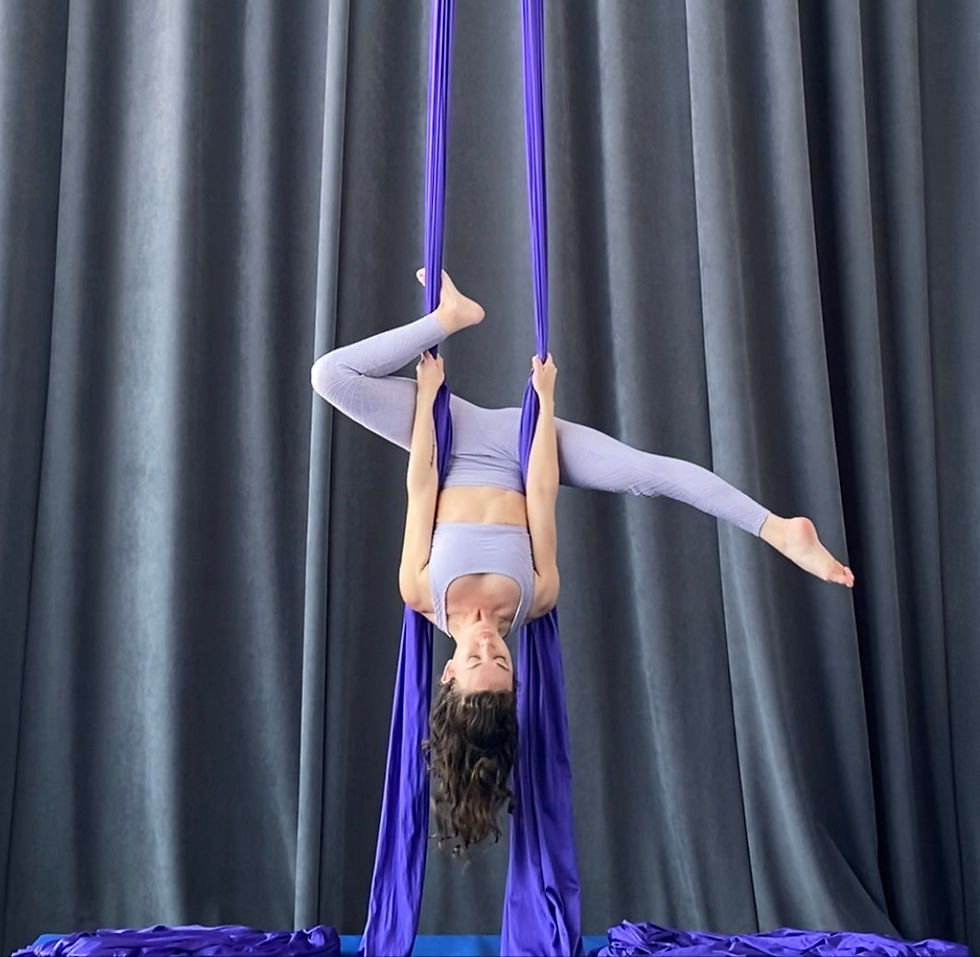
👀 Can You Spot the Mistake? Knee Hooks

Let’s take a closer look at something we use all the time. It’s one of those things you may do without thinking. As aerialists, we hook our knees on the apparatus again and again.
Prepping for catchers = knee hook
Inversion climbs = knee hook
Setting up for drops = knee hook And sooo many more skills!
It shows up more often than we tend to think about. It’s one of those positions, or in-between moments, that feel simple, which is exactly why they often get overlooked.
Many aerialists, even experienced ones, could refine this more than they realize.
We often blame slippery leggings when a knee hook doesn’t feel secure. And yes, fabric can play a role. But more often, it comes down to positioning, engagement, and how the hook is actually being placed. While cues like “lift your hips higher” are well-intended, they don’t always address the underlying issue for lasting improvement.
When we train, and especially when we teach, our responsibility isn’t only to know what a skill should look like. It’s to recognize when something is off and know how to guide it back to a stronger, more secure position.
See the video below for a breakdown and improvement tips! ⬇️
Main Mistakes:
❌ Knee hooking directly on top of the hands This can feel unstable and precarious, especially when adding steps afterwards like catchers or inversion climbs.
❌ Rounded upper back in your inversion with hips low
This makes it much harder to place the knee in a strong, secure position.
❌Open hips with little hamstring engagement
This weakens the connection of the hook and reduces grip. If you often feel like you’re slipping, or catch yourself blaming your leggings, this is likely why.
What to do instead:
In your inversion: ✔️Lengthen through your spine ✔️Widen across your collarbones ✔️Gently draw your shoulder blades together
This helps bring your hips closer to the silk and higher as a result of better alignment not force. Focusing only on lifting the hips won’t always do the trick.
In your knee hook:
✔️Aim for a straight line from knee to ankle (avoid turning out from your hips) ✔️Press the baby toe edge of your foot gently toward the silk, this helps to secure you even more! ✔️ Squeeze your heel toward your bum to engage the back of the leg, especially the hamstrings
✔️ Fully point through the top of your foot, avoid a “crunchy foot” where the toes curl under and the ankle slightly flexes
Why this matters:
Because something as “simple” as a knee hook, especially when taken higher up, carries more risk and consequence when it’s off. A more connected upper body and active leg engagement creates a stronger, more secure knee hook.
Enjoy learning about the small details that make a big difference? Refining technique and understanding the “why” behind skills?
Our Online Level One Silks Teacher Training may be a great next step.
Applications and enrollment are open from May 1–29, 2026.
Curious to learn more? Click here.